What to Expect from Your
Indian Wedding Photography Timeline
A candid, ceremony-by-ceremony guide from photographers who have lived every magical, chaotic, tear-filled moment of a South Asian wedding day.
Planning an Indian wedding is an experience unlike any other. It is layered, luminous, and — let us be honest — wonderfully overwhelming. And right in the middle of all that colour, emotion, and sacred ritual is your photographer, quietly working to capture every single moment that matters.
If you have ever Googled "Indian wedding photography timeline" at 11 p.m. while drowning in vendor spreadsheets, this post is for you. Over the years, we at The Wedding Stories have had the privilege of photographing South Asian weddings across the country — from intimate Hindu ceremonies in family backyards to grand Sikh celebrations in ornate banquet halls. And one thing we hear from nearly every couple is the same: no one told us how long everything would actually take.
So consider this your honest, ceremony-by-ceremony guide. Not a generic "get ready, get married, have cake" timeline — but a real, South Asian wedding photography roadmap built from lived experience.
Every South Asian wedding is different. Hindu, Sikh, Muslim, Jain, Christian-Indian — each tradition carries its own rituals, its own rhythm, and its own timeline. The guidance here reflects the most common elements across these celebrations. Your photographer should always build a custom timeline with you, not copy a template from a blog. (Even this one.)
Why the Indian Wedding Photography Timeline Is Different
If you have attended a South Asian wedding as a guest, you already know: Indian weddings do not follow a clock. They follow a feeling. A Baraat might arrive an hour late because someone's uncle stopped for chai. A Phera ceremony might run long because the pandit added an extra set of mantras out of respect for the family. A Joota Chupai game might turn into a 45-minute negotiation between the bride's cousins and the groom.
This is not a flaw. It is a feature. It is the warmth and the spontaneity that makes South Asian weddings so extraordinarily alive.
But it does mean that your Indian wedding photography timeline needs to be built with a buffer of at least 30–45 minutes into every major transition. A Western wedding photographer used to precise 15-minute slots will struggle here. A South Asian wedding photographer — one who understands the culture, the ceremonies, and the people — will not only expect the delays but plan for the most beautiful shots within them.
The best Indian wedding photographs are never taken on schedule. They are taken in the moments between the schedule.
— The Wedding StoriesPre-Wedding Events: Where the Story Begins
Most Indian weddings are not a single-day affair. They are a multi-day celebration, and for South Asian wedding photographers, each pre-wedding event is its own chapter in your love story.
The Mehendi (Henna) Ceremony
The Mehendi is typically held one to two days before the wedding, and it is a celebration of artistry, togetherness, and quiet anticipation. For us at The Wedding Stories, the Mehendi is not where we spend the most hours — but it is where some of the most beautiful detail photographs of the entire week are made.
We arrive once the henna work on the bride's hands and legs is complete. At that point, the story we are telling is not about the application process — it is about the finished art, the mood, and the people gathered around it. We focus on close-up detail shots of the intricate Mehendi patterns, followed by relaxed portraits of the bride with her groom, family, and friends.
Photography Coverage · 1–2 Hours
This is intentionally focused coverage. We are not there all day — we are there for the shots that matter most: the henna in its full, finished glory, the couple portraits while the bride is adorned, and the candid warmth of everyone gathered together.
Have the Mehendi fully applied on both hands and legs before we arrive. This allows us to dedicate all of our time to portraits and detail photography rather than waiting — and the final henna at its deepest colour is always the most striking on camera.
The Sangeet Night
If the Mehendi is intimate, the Sangeet is electric. This is the night of music, dancing, and performances — where both families come together, shed their formality, and celebrate with everything they have. As South Asian wedding photographers, the Sangeet is one of our favourite events to document. The stage lights, the colour, the emotion on parents' faces when their children perform — it is extraordinary.
Photography Coverage · 4–6 Hours
Coverage includes décor and venue shots at the start, all family and couple performances, candid dancing, and a formal couple portrait session if the setting allows. For the Sangeet especially, make sure your photographer has experience shooting in low, dynamic stage lighting. This is not the moment for a photographer still learning their camera.
The Haldi Ceremony
The Haldi — where turmeric paste is applied to the bride and groom by family members — is joyful, messy, and utterly photogenic. It is one of those ceremonies that looks effortless in photographs but requires a photographer who knows exactly when to move in and when to let the moment breathe.
Photography Coverage · 1.5–2 Hours (Hindu & Punjabi) · 4 Hours (Gujarati)
For most Hindu and Punjabi weddings, the Haldi itself moves quickly and our coverage sits comfortably in the 1.5 to 2-hour range. For Gujarati weddings, however, the Haldi is preceded by a full Pooja ceremony — a sacred ritual that begins the morning and flows into the Haldi application around midday. In that case, we plan for approximately 4 hours of coverage to do both ceremonies justice. The Pooja typically begins around 9 a.m., with the Haldi starting around noon. That entire arc — from the prayers to the turmeric — is a visual and emotional story worth telling in full.
Dress yourself and your family in white or light colours for the Haldi — the turmeric contrast is extraordinary on camera. And do tell your guests: embrace the mess. The best Haldi photographs are never the careful ones.
The Wedding Day: Ceremony by Ceremony
Now we come to the main event. Here is what a typical Indian wedding photography day looks like at a glance — and then, ceremony by ceremony, how we think about each moment.
Getting Ready: The Bridal Suite
The getting-ready portion of your Indian wedding photography timeline is so much more than hair and makeup. It is the quiet calm before the celebration begins. It is the moment your mother helps fasten your jewellery and breaks into tears. It is your bridesmaids crowding around to see you in your lehenga for the first time. And because South Asian weddings begin early — we are talking a 6 a.m. start — that calm is wrapped in the soft, golden light of a morning that the rest of the world is only just waking up to.
Photography Coverage · 2 Hours · 6:00–8:00 AM
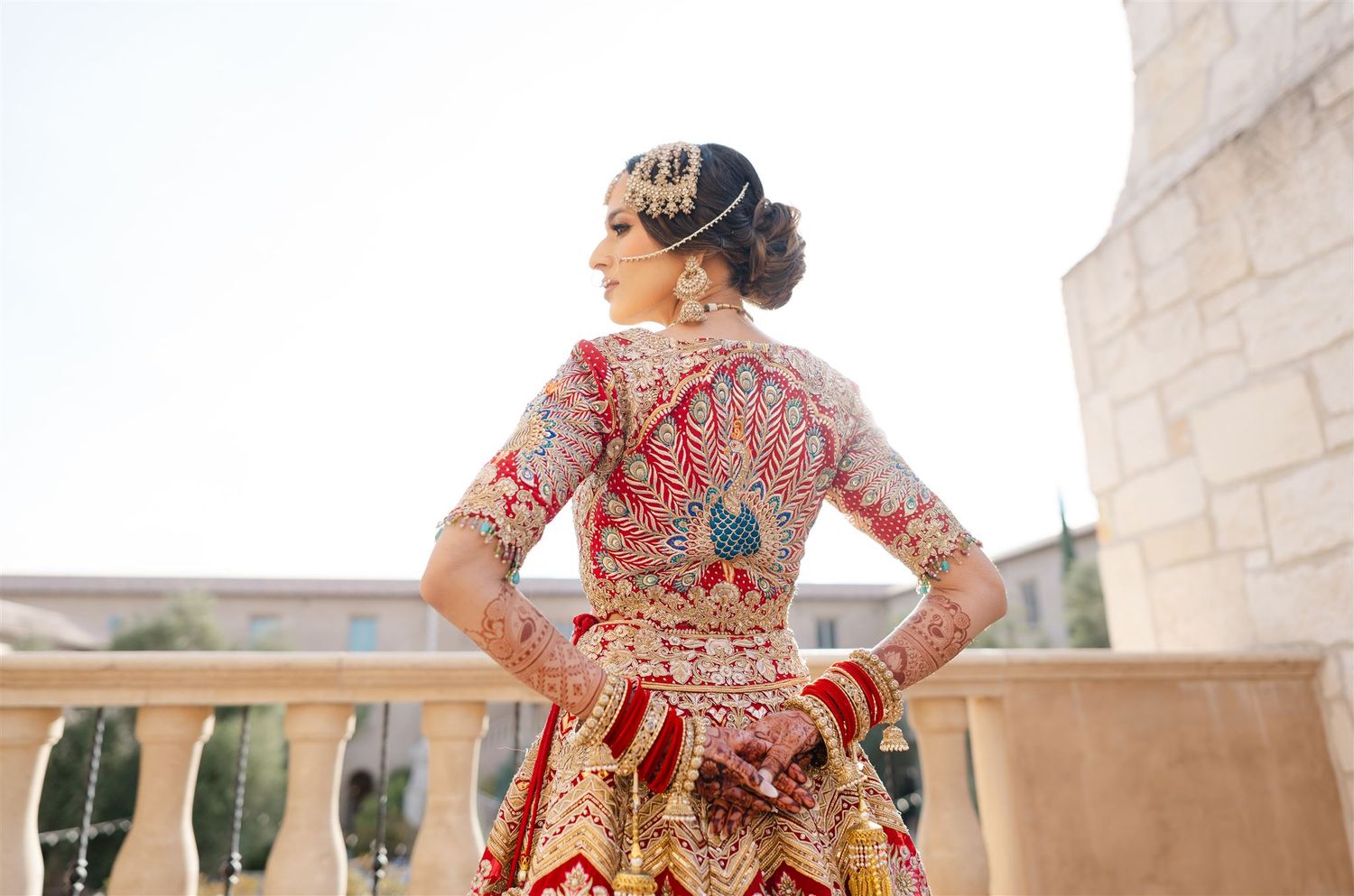
For South Asian brides especially, the getting-ready period is critical to photograph well, because there is simply so much detail — the bridal Chura, the Maatha Patti, the Passa, the Nath, the layered necklaces, the embroidered dupatta. We arrive at 6 a.m. sharp and work methodically through every detail before the Baraat arrives.
- Schedule your hair and makeup artist to begin before 6 a.m. so you are nearly ready when we arrive
- Have your bridal jewellery laid out for detail shots before putting it on
- Keep a small, well-lit corner of the room clear for portrait shots in your lehenga
- Plan a quiet "first look" moment with your parents — these are some of the most emotional photographs of the entire day
- Let your photographer know the order in which you will dress, so they can sequence their shots accordingly
The Baraat: High Energy, High Stakes
The Baraat — the groom's wedding procession — is one of the most dynamic sequences in all of South Asian wedding photography. There is dhol, there is dancing, there is the groom arriving on a horse (or, increasingly, a white SUV decked in flowers). Everything is moving, everything is loud, and everything is happening at once. And at a morning wedding, it all happens fast.
Photography Coverage · 30 Minutes · 8:30–9:00 AM
This is where having a second shooter is not a luxury — it is a necessity. While one photographer documents the energy of the Baraat from the front, a second should be at the venue capturing the bride's family watching and waiting. Those reaction shots — the look on the bride's face as she first hears the dhol — are irreplaceable, and at 30 minutes, there is no time to miss them.
Because the Baraat at a morning wedding happens in early light, confirm with your photographer that they are set up and ready before the procession begins moving. The opening moments — the groom mounting the horse, the first beats of the dhol — cannot be recreated.
The Milni: A Moment Often Overlooked
The Milni — the formal meeting of both families — tends to get skipped over in photography planning conversations, and that is a mistake. The garland exchanges, the embraces between elders who may be meeting for the first time, the laughter as the groom's family tries to lift one of the bride's uncles — these are genuine, warm, documentary moments that tell the story of two families becoming one.
Photography Coverage · 15 Minutes · 9:00–9:15 AM
It moves quickly. We move with it. This is followed by breakfast — a natural pause in the day where we capture candid moments of guests and family sharing a meal before the ceremony begins.
The Ceremony: Your Most Sacred Hours
The length of your wedding ceremony will vary significantly depending on your tradition and your pandit or officiant. A Hindu wedding with full Saptapadi (the seven steps around the sacred fire) typically runs 2 hours. A Sikh Anand Karaj ceremony in a Gurudwara usually takes 45 minutes to 1.5 hours, with strict rules around photography. A Muslim Nikah can be relatively brief, but the surrounding rituals often extend the coverage.
A photographer who has shot dozens of Indian weddings will already know the key ritual moments — the Mangalsutra, the Sindoor, the Pheras, the Saptapadi, the Varmala exchange — and will be positioned to capture each of them without prompting.
Photography Coverage · 2 Hours · 10:00 AM–12:00 PM
- Ask your pandit which moments are most sacred and should not be interrupted for photography
- Ensure your photographer has a long zoom lens — intrusion into the ritual space is both disrespectful and disruptive
- Plan a brief moment immediately after the ceremony for a quick couple portrait before family rushes in
- Communicate any no-photography zones (e.g., inside a Gurudwara during Ardas) to your photographer well in advance
Family Photos, Lunch, and the Vidai
Once the ceremony concludes, the afternoon follows a rhythm we have carefully built to honour every relationship and every farewell. Family photographs come first — while everyone is still dressed, styled, and emotionally present. Then comes lunch, a brief and necessary pause. And then, quietly, the Vidai.
Family Photos · 1 Hour · 12:00–1:00 PM
This is the most structured block of the wedding day. We work through immediate family, extended family, and any specific groupings you have requested. We always recommend preparing a shot list in advance and assigning a family member as a coordinator — it keeps things moving and ensures nobody is missed.
Lunch · 30 Minutes · 1:00–1:30 PM
A moment to breathe, eat, and be present with your guests before the emotional weight of the Vidai arrives.
Vidai · 15 Minutes · 1:30–2:00 PM
The Vidai — the bride's farewell — is one of the most emotionally powerful moments in all of South Asian wedding photography. When a bride walks away from her parents, there is something ancient and profound happening. A great photographer knows to be ready for it, not to interrupt it, and to let it breathe. Do not schedule anything immediately after. Give this moment its space.
Couple Portraits and Bridal Party
After the Vidai, the afternoon opens into the most creative hours of the day. The ceremony is behind you. The evening reception is still ahead. And for a brief, golden stretch of afternoon light, it is just the two of you.
Couple Portrait Session · Minimum 1.5 Hours · 2:00–3:30 PM
Please, protect this time. We ask for a minimum of 90 minutes for your couple portraits, and we mean it. This is where the images that will hang on your walls for decades are made — unhurried, thoughtful, and beautiful. In our experience, the most common regret couples have about their wedding photography is not giving this session enough time.
Couple Portraits Begin
Just the two of you. We lead, you follow, and we find the light together.
Final Couple Frames
The last 30 minutes produce the most relaxed, natural images — when you have forgotten the camera is there.
Bridal Party Photos
30 minutes for bridesmaids, groomsmen, and combined group shots. Kept fun, kept moving.
Rest Before Reception
A rare and precious hour to refresh before the evening begins.
The Reception: Where the Night Comes Alive
The Indian wedding reception is a world of its own. Grand entrances, speeches that make everyone cry and then laugh, a first dance, parent dances, dinner, and then — inevitably, gloriously — hours of dancing that nobody wants to end.
Photography Coverage · 5–6 Hours · 5:00–11:00 PM
We cover your grand entrance, the first dances, all speeches, cake cutting if applicable, and the open dance floor. Many South Asian couples choose to do a late-night portrait session — stepping away for 15 minutes when the dance floor is full and nobody notices you have slipped out. Those images, lit by the glow of the evening, are consistently among our couples' most treasured.
A Sample Full Indian Wedding Week
Here is what a full South Asian wedding week looks like when you plan it thoughtfully — five events, each with its own rhythm, its own emotional weight, and its own photography requirements.
Many couples today choose to combine the Mehendi and Sangeet into one grand, joint celebration — bringing both sides of the family together in a banquet hall for an evening that holds the intimacy of the Mehendi and the energy of the Sangeet in a single, spectacular event. When this happens, we plan for 4–6 hours of combined coverage. Similarly, some couples hold their wedding and reception on the same day, which we cover as a continuous 10–12 hour day from morning preparations through to the last dance.
We arrive once the henna is fully applied — for detail shots of the finished Mehendi, couple portraits, and candid family and friends photography.
Full coverage of décor, all performances from both families, couple entrance, and open dancing. Stage lighting expertise is essential here.
For Gujarati weddings: Pooja begins at 9 a.m., Haldi at noon — we cover both as a continuous story. For Hindu and Punjabi weddings: focused Haldi coverage of 1.5–2 hours.
Getting ready through Baraat, Milni, Breakfast, Ceremony, Family Photos, Lunch, Vidai, Couple Portraits, and Bridal Party. A full, beautiful, exhausting, extraordinary day.
Grand entrance, first dances, speeches, dinner, and dancing until the very last song.
How to Choose a South Asian Wedding Photographer Who Understands Your Timeline
Not every wedding photographer is equipped to shoot an Indian wedding. And that is not a criticism — it is simply the truth. South Asian weddings require a photographer who understands the cultural weight of each ceremony, knows when to step forward and when to step back, can communicate with family members who may not speak English, and has the technical skills to shoot everything from a low-lit Gurudwara to a blazing afternoon Baraat.
When you are interviewing South Asian wedding photographers, ask these questions:
- How many Indian or South Asian weddings have you photographed?
- Are you familiar with my specific tradition and ceremony?
- Do you work with a second shooter, and what do they cover?
- How do you build and manage our wedding day timeline?
- Can I see a full gallery from a South Asian wedding, not just highlight images?
- How do you handle delays or unexpected changes in the schedule?
- Have you worked at our venue before?
Frequently Asked Questions
How many hours of photography coverage do I need for my Indian wedding?
For a full South Asian wedding day with ceremony and reception, most couples need between 10 and 14 hours of coverage. If you are including pre-wedding events like the Mehendi and Sangeet, budget for additional coverage on those days.
Do I need a second photographer for my Indian wedding?
Yes — strongly recommended. Indian weddings have too many simultaneous moments for one photographer to capture alone. While one shooter is with the groom during the Baraat, another needs to be with the bride. A second shooter is not an upsell; it is a necessity for comprehensive Indian wedding photography.
What if my ceremony runs over time?
It almost certainly will. Build buffer time into your timeline — ideally 30 to 45 minutes after every major event — and talk to your photographer about which moments are absolutely non-negotiable. Most importantly, choose a photographer who has experienced Indian wedding timing before and will not panic when things run late.
When should I schedule couple portraits on my wedding day?
At The Wedding Stories, we schedule couple portraits in the early-to-mid afternoon after the Vidai — typically 2:00 to 3:30 PM. This gives you beautiful afternoon light and the emotional freedom that comes after the ceremony is complete.
Should I have my Mehendi and Sangeet photographed?
Absolutely. Some of the most emotionally resonant photographs from South Asian weddings come from pre-wedding events. Do not treat the Mehendi and Sangeet as afterthoughts in your photography coverage — they are where your story truly begins.
Ready to Build Your Wedding Day Timeline?
Every South Asian wedding is a unique, layered, extraordinary story. Let's build a photography plan that captures yours — not just the rituals, but the real moments in between.
Book a ConsultationOne Final Thought
We have stood in Gurudwaras as a couple completed their Laavan, tears streaming down the faces of parents who had waited decades for this moment. We have chased Baraats down sun-drenched streets. We have watched brides take that final look back during the Vidai. And we have learned something that no timeline can teach you:
The most important photographs from your Indian wedding will not be the ones that were planned. They will be the ones that happened in the five minutes nobody accounted for. The timeline exists to protect the space for those moments to occur. Our job is to be ready when they do.
Plan thoughtfully, build in breathing room, choose a South Asian wedding photographer who truly understands your tradition — and then let the day unfold as it will.
Your Indian & Hindu Wedding Photography Checklist
Everything to confirm, prepare, and communicate with your photographer in the month before your wedding.
Four Weeks Before — Confirm the Plan
- Confirm your full photography coverage schedule — every event, every start time, every location address
- Share the final venue details, including parking and photographer entry point, with your photographer
- Confirm whether a second shooter is included and what they will be covering
- Discuss any ceremony restrictions — no-photography zones, Gurudwara protocols, Pandit preferences
- Share a list of must-have family group photographs so your photographer can plan accordingly
- Confirm turnaround time for your edited gallery and what the delivery format will be
- Identify one trusted family contact (a coordinator) who will help round up family for formal portraits
Pre-Wedding Events — Mehendi, Sangeet & Haldi
- For the Mehendi: confirm that henna will be fully applied on both hands and legs before your photographer arrives
- Have the bridal jewellery and accessories set out for close-up detail shots at the Mehendi
- For the Sangeet: share the performance order and any special introductions with your photographer in advance
- Confirm that the Sangeet venue allows photography and that stage lighting is in place before coverage begins
- For the Haldi: dress yourself and family in white or light colours — turmeric on white is always the most striking on camera
- For Gujarati weddings: confirm the Pooja start time (usually 9 a.m.) so your photographer is there from the beginning
- Assign someone to keep the Haldi space clear of bags, phones, and clutter for a clean photographic environment
Wedding Morning — Getting Ready
- Hair and makeup should begin early enough that you are nearly fully dressed by 7:30–7:45 a.m.
- Lay out all bridal jewellery — Maatha Patti, Passa, Nath, Chura, Haath Phool, necklaces — on a clean, light-coloured surface before your photographer arrives at 6 a.m.
- Keep the getting-ready room tidy and well-lit — natural light near a window is ideal
- Have your outfit (lehenga, saree, or suit) on a hanger and ready for a detail shot before you wear it
- Reserve a quiet corner of the room for emotional family moments — first look with parents, Chura ceremony, blessings
- Keep the number of people in the getting-ready room manageable — a quieter, more intimate space always photographs better
Ceremony Day — Logistics
- Provide your photographer with the Pandit or officiant's name and contact if there are any ritual-specific photography guidelines
- Confirm seating arrangements so your photographer can identify the best positions for ceremony coverage
- Ask the venue or banquet hall about any restrictions on flash photography during the ceremony
- Have a dedicated family member as the "family wrangler" for formal portraits — someone who knows all extended family members by name
- Communicate to close family that the formal portrait hour (12–1 p.m.) is non-negotiable — everyone should be present and ready
- Arrange a small lunch plate for your photographer and second shooter during the guest lunch break
The Vidai — Prepare the Moment
- Do not rush the Vidai. Keep the 1:30–2:00 p.m. window clear and free of any other tasks or conversations
- Let close family know in advance that the Vidai will be emotional and that space should be given — not everyone needs to crowd the door
- If your Vidai is happening at a family home rather than a venue, notify your photographer of the address and access details
- Trust your photographer to work quietly and unobtrusively during this moment — the best Vidai photographs are never directed
Couple Portrait Session — Protect Your Time
- Block the 2:00–3:30 p.m. window firmly on your schedule and communicate it to all family members — this time is yours alone
- If there is an outdoor portrait location you love, share it with your photographer at least two weeks in advance so they can scout it
- Keep a small emergency kit nearby — blotting papers, a comb, safety pins, lipstick — for quick touch-ups between shots
- Leave your phone with a trusted family member during the portrait session — this time photographs better when it is truly just the two of you
- Trust the process. Your photographer will guide you. You do not need to know what to do with your hands.
Reception Evening — Final Details
- Share the reception programme with your photographer — performance order, speech schedule, first dance song, and any surprises
- Confirm the reception venue's lighting situation. If the hall is very dark, discuss off-camera lighting with your photographer in advance
- Brief your MC to hold any announcements briefly so your photographer can move into position before each key moment
- If you want a late-night couple portrait session during the reception, plan it for approximately 9–9:30 p.m. when the dance floor is full
- Ensure your photographer has a clear sightline to the stage or head table from their coverage position
- Allow your photographer to eat before the open dancing begins — they work better on a full plate
General Reminders for Every Event
- Always have your photographer's phone number saved and shared with a point-of-contact on your team
- Send your photographer a final schedule PDF at least one week before the first event
- If anything changes — venue, timing, family additions — communicate it as early as possible
- Trust that delays will happen. Build buffer time into every transition and let your photographer manage the flow
- On the day itself: breathe, be present, and let your photographer do what they do. The photographs will take care of themselves.
A great wedding photography experience is a partnership. The more prepared you are, the more freely we can work — and the more freely we work, the more honest and extraordinary your photographs become.
If you have questions about any of the above, or if you would like to walk through your specific timeline with us before your wedding month, we are always just a conversation away.


